

- 201 Views
- 26 Min Read
- (0) Comment
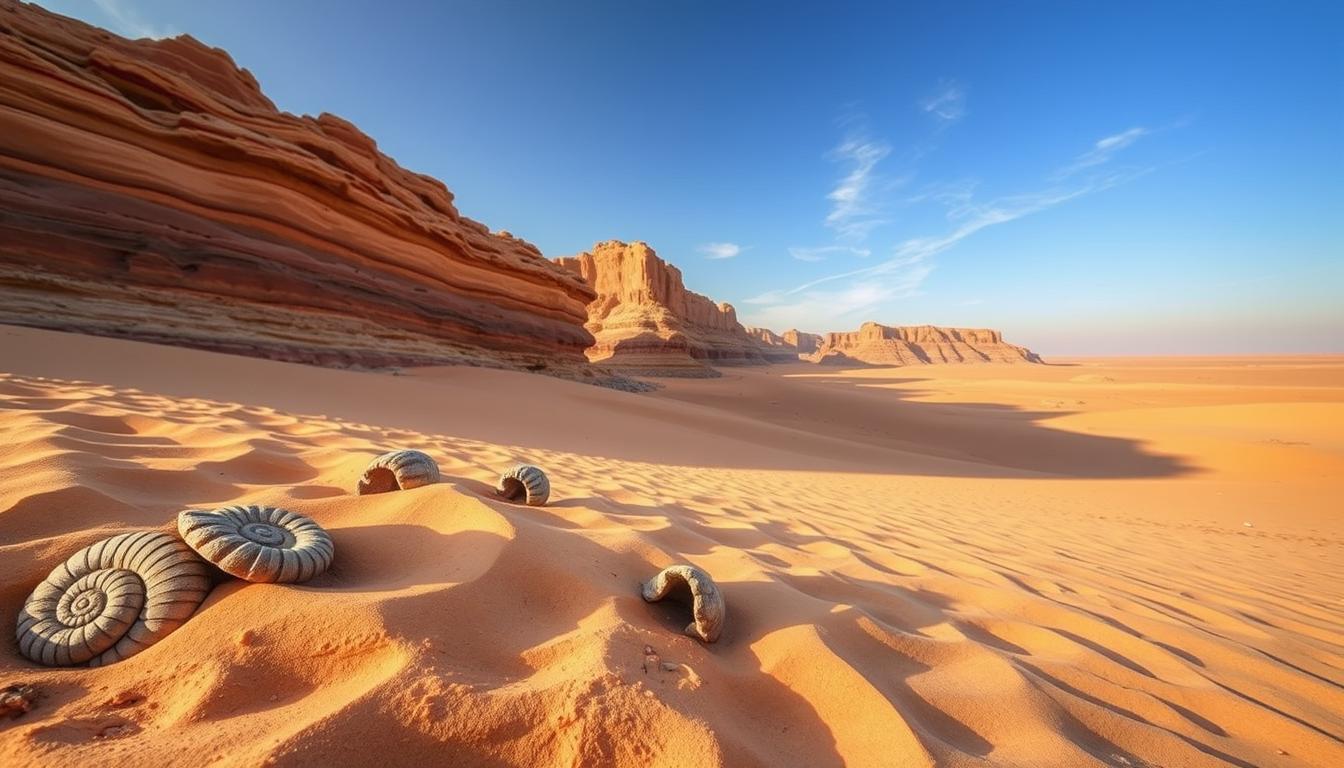
You stand at the edge of the dunes, with the wind as your quiet guide. Every sand grain whispers secrets of an ancient world, from a time when warm seas covered what now is a vast desert. This experience shows why The Geology Behind Sharjah’s Fossil-Rich Desert is more than just a topic. It’s a way to directly read the deep passages of time.
The silence here holds countless stories engraved in stone. You find reef-built limestone, beds of crushed shells, and desert pavements created by endless erosion. As you follow a ridge or the floor of a wadi, you begin to see Sharjah’s geology as a tactile map. It reveals how ancient currents, shifting shorelines, and mineral transformations have preserved fossils for us to find — carefully and with respect.
This guide prepares you for a journey driven by science. You’ll understand the order of rock layers, why sediments from different ages are still informative, and how fossils get preserved in carbonates. It also covers how to explore this area safely. There’s info on where you can get help for field access in the UAE. And it stresses the importance of conservation at every step.
Key Takeaways
- You read time in layers—Sharjah geology turns dunes, wadis, and rock ledges into a living timeline.
- Fossil-rich carbonates and desert pavements reflect ancient seas and long erosional cycles.
- Understanding stratigraphy helps you link fossils to the right geological formations Sharjah.
- Diagenesis can preserve fine details, shaping how fossils look and what they reveal.
- Responsible field habits protect fragile sites and keep research opportunities open.
- Clear routes and safe access let you explore The Geology Behind Sharjah’s Fossil-Rich Desert without harm.
Overview of Sharjah’s Fossil Heritage and Why It Matters
You’re standing where seas once shifted and dunes rose. Sharjah’s ground, with its limestone and sandy plains, keeps millions of years of life’s history. As you look around, you uncover stories from the Sharjah fossils. These tales connect to the big picture of paleontology in the UAE.
What makes Sharjah fossils globally significant
Sharjah is home to plenty of marine fossils, from shells to corals. These fossils were part of an ancient sea, the Neo-Tethys. They show us how vibrant and full of life these waters were. Studying these fossils from Sharjah reveals sea-level changes and habitat shifts very clearly.
These fossil sites are well kept, allowing researchers to look closely at them. This detail helps them understand big patterns in Earth’s history. Sharjah’s fossils connect to findings in Oman and Saudi Arabia. This gives us a clear map of the ancient environments, more than just a list of old creatures.
How desert fossils in Sharjah reveal ancient ecosystems
When the seas went back, they left behind traces like tracks and burrows. These are clues of ancient behaviors, not just remains. Desert areas add more pieces to the puzzle: signs of old plants, wind patterns, and changes from beaches to dunes.
Studying minerals in these fossils tells us about ancient climates. Things like iron stains and silica show how the environment changed. With Sharjah’s desert fossils, we can understand ancient diets, shore shifts, and weather changes through the textures they left behind.
Why you should explore Sharjah geology responsibly
Taking fossils without understanding their place can erase important information. Collecting without care can damage these historical layers. In the UAE, careful record-keeping links fossils to their exact locations. This preserves the area’s geological history for both learners and experts.
Follow simple rules: take photos and note details without removing anything. Report any big finds to the authorities or universities. Don’t take anything home unless you have permission. This way, you help keep Sharjah’s paleontological history available for everyone in the future.
| Clue in the Rock | What You Learn | Where It Appears | Why It Matters |
|---|---|---|---|
| Coral frameworks and shell beds | Warm, shallow marine conditions and biodiversity peaks | Carbonate platforms of coastal Sharjah | Anchors sea-level history and habitat richness in Sharjah fossils |
| Burrowed horizons and trace fossils | Behavior, sediment mixing, and oxygen levels | Nearshore and tidal settings | Links activity patterns to paleoecology in paleontological discoveries UAE |
| Eolian cross-beds and soil nodules | Desert winds, dune migration, and emergent plains | Young terrestrial deposits | Clarifies transitions seen in desert fossils Sharjah |
| Calcite and silica cements | Burial fluids, salinity changes, and diagenesis | Limestones and sandstones | Preserves fine detail that supports age and environment analysis |
The Geology Behind Sharjah’s Fossil-Rich Desert
You’re standing on land shaped by time and water. Sharjah’s ancient seas made thick carbonate layers, while winds formed dunes. These layers help uncover Sharjah’s Geology and where to find fossils.
Primary rock units and stratigraphy shaping fossil deposits
You’ll find large limestones and dolomites formed in shallow waters, mixed with marls and sandstones from lagoons and shores. On top, younger sands from dunes cover these, revealing or hiding older layers after storms.
The way rocks stack up is key. Transgressive lags capture shells; regressive phases show tidal flats clearly. This helps find fossils in Sharjah, where certain patterns mean better preservation.
Sedimentary environments that preserve marine and terrestrial life
Reefs and lagoons are good for finding corals and shells, held in place by early cements. Estuaries and dry areas show tracks and textures, giving clues about ancient life.
Looking at different rock layers, you can tell where storms hit or calm waters laid mud. This helps us understand Sharjah’s fossil-rich areas like reading a coast’s history.
Diagenesis and mineralization processes affecting fossil quality
Over time, changes like cementation and staining modify the fossils you find. This can make details clearer or lock fossils in solid rock.
Changes in porosity and mineral deposits can affect a fossil’s look and feel. Understanding these changes in Sharjah helps link fossils to how the land and waters moved long ago.
Geological Timeline: From Ancient Seas to Modern Dunes
You’re walking into a story told by stones. Warm waters from the old Neo-Tethys seas once washed over the Arabian Platform. Then, it all changed to wind-blown sands. This journey in time shows how Sharjah’s fossils formed layers that we can read today. It also tells how the geology of Sharjah shapes every place you see.
Mesozoic and Cenozoic chapters in the UAE stratigraphic record
In the Mesozoic era, shallow seas were home to ammonites and reef-builders. These creatures lived on clear carbonate shelves. As you discover fossils across the UAE, you find stable areas where life flourished. Here, creatures left behind marks that have lasted through time.
Then came the Cenozoic era, introducing broad marine changes over the lands. New layers of carbonates covered the old ones. The life of mollusks and corals got preserved in these shelf and lagoon areas. Today, they anchor numerous Sharjah fossils that you come across in your studies.
Transgressive-regressive cycles and fossil layering
Sea levels rose and fell many times, creating layers of shells and fossils. You can spot places where time seems condensed but fossils are plentiful. This pattern helps with detailed study of Sharjah’s geology through the rock faces.
Global and local forces caused these cycles, dividing habitats in a rhythm. This rhythm resulted in neat layering. This lets you link species changes to the past shorelines within the UAE’s paleontological discoveries.
Climatic shifts and their imprint on Sharjah geology
The rise of the Hajar Mountains led to a drier climate. Winds blew away finer materials, dunes grew, and salt flats formed. These flats cover layers of marine beds with Sharjah fossils just below.
Climate changes left behind clues like soil crusts, salts, and worn-away layers. These clues help date the rock layers. They tie Sharjah’s geology to wider changes in the region, linking it to other discoveries in the UAE.
Key Geological Formations in Sharjah
Sharjah’s geology is a vivid patchwork. You’ll find carbonate bedrock sliced by ophiolitic highs. It’s all covered by young desert sands. These formations offer a peek into the past. They let you study desert fossils with ease.
Limestone platforms and fossil-rich carbonates
Bedded limestones and dolostones line low hills. They hold dense layers filled with ancient marine life. You’ll see corals and shells embedded in the rocks, typical of Sharjah’s geology. Look for color bands that tell stories of ancient seas.
Fossils become clear when weathered stone or rare rains reveal them. Their crisp textures stand out in the sunlight.
Ophiolite influence from the Hajar Mountains region
Near the Hajar Mountains, the land rises. Oceanic crust lifts up, shaping the terrain and water paths. Debris from these mountains adds color and history to the landscape. It mixes greenish stones with pale carbonate fragments.
Erosion around raised areas uncovers interesting rocks. These spots are great for comparing ophiolitic debris with fossil beds. They’re often easy to reach.
Alluvial fans, sabkhas, and dune fields shaping the landscape
Gravels from mountains spread out, forming wide fans. They thin into sabkhas with salty crusts and tiny life forms. The wind-sculpted surfaces hold signs of early fossil formation, different from those in limestone.
Dunes cover but also expose the ancient bedrock. Storms and wind create openings that show layers of stone. This connects shifting sands with the stable rock beneath, completing your view of Sharjah’s geology.
Paleontological Discoveries in the UAE You Can Learn From
Imagine stepping onto ancient lands once covered by seas. In Sharjah, fossils act as a guide to the past, telling stories of time, climate, and changing coastlines. Every shell, imprint, and layer you discover is a clue, not just an object to take home.
Iconic marine fossils: ammonites, corals, and bivalves
Ammonites take you back to the times of the Mesozoic, serving as markers of ancient seas that have long since disappeared. Coral remains tell us how reefs grew and changed over time, from their beginnings to being broken by storms. Meanwhile, bivalves and gastropods give us insights into the past environments of lagoons and shores, helping us refine our understanding of Sharjah’s fossils.
Trace fossils and what they tell you about behavior
Looking at burrows, trails, and escape paths reveals how ancient creatures lived, ate, and avoided dangers. The size and arrangement of these traces tell us about past oxygen levels and how quickly sediments were deposited. Through these remnants, we learn how life adapted to its surroundings, adding depth to our knowledge of UAE’s paleontological finds.
Recent scientific study of Sharjah fossils and field methods
Modern methods are making it easier to understand the past. Techniques like logging of rock layers, analyzing tiny fossil features, and checking the chemistry of rocks help pinpoint environments of long ago. Dating of rocks using uranium-lead and strontium isotopes clarifies how old they are, fitting them into the big picture of sea-level changes and making studies of Sharjah fossils more precise.
Scientists use GPS and drones to map where fossils are found. They then use GIS to follow changes in the landscape and where different types of fossils are located. When researching, it’s key to mix detailed field notes with precise measurements to create a clear story of Sharjah’s fossil record.
| Fossil or Feature | What You Observe | Environmental Signal | Field Method Commonly Used |
|---|---|---|---|
| Ammonites | Coiled shells with ribbing and sutures | Biostratigraphic markers for Mesozoic marine settings | Bed-by-bed logging; conodont-free isotope screening to avoid diagenetic bias |
| Coral frameworks | Massive heads and rubble lenses | Reef growth stages and storm reworking | Microfacies thin sections; drone orthomosaics to map patch reefs |
| Bivalves and gastropods | Shell orientation, size sorting, biofabric | Energy gradients and salinity shifts across lagoons | Grain-size analysis; Sr isotopes for age constraints |
| Burrows and trails | Vertical shafts, horizontal meanders, spreiten | Oxygenation, sedimentation rates, organism behavior | Ichnofabric indexing; GNSS grid mapping of surfaces |
| Fossiliferous horizons | Layer-bound concentrations of shells or coral | Transgressive-regressive stacking and accommodation | Measured sections; U-Pb dating of interbedded carbonates |
Takeaway: Pay close attention to the connection between each fossil and its surroundings. This way, our understanding of UAE’s paleontological treasures and scientific research on Sharjah fossils grow stronger together.
How Fossils Form in Arid Desert Environments
In the deserts near Sharjah, fossils start to form with rapid burial. Storm surges, moving dunes, or sabkha growth protect shells and bones quickly. This keeps them safe from animals and air. Then, waters rich in carbonate begin to cement the remains fast. This preserves delicate textures before they are compressed by weight and heat.
Along coastal sabkhas, evaporation causes minerals to move up and solidify around grains and tracks. This sometimes captures microbial mats and footprints in stone. It shows how geology and chemistry come together in Sharjah’s fossil-rich desert. Here, minerals encase soft details not found in other climates.
The process of being exposed adds to the fossil’s story. Wind smooths surfaces and desert varnish makes fossils darker. This tells us how long the fossils have been exposed in Sharjah. Groundwater also plays a role by dissolving some minerals and replacing them with others. This leaves behind clear molds and casts.
In Sharjah, you find various fossil beds. Some have corals stuck in hard cement. Others have fragments left behind after the sand was blown away. Each pattern tells us about the environment, water, and how quickly things were buried.
Imagine you’re a taphonomist walking through dunes and sabkhas. Consider how rapid coverage, mineral formation, and erosion reveal the history you’re seeing today.
| Process | Desert Mechanism | Typical Evidence You Observe | What It Suggests in Sharjah geology |
|---|---|---|---|
| Rapid Burial | Dune migration, storm sheets, sabkha crust growth | Articulated corals, intact bivalves, sharp shell edges | Low scavenging time and quick sealing tied to The Geology Behind Sharjah’s Fossil-Rich Desert |
| Early Cementation | Carbonate-rich pore waters harden sediments | Cemented beds with preserved microtextures | High bicarbonate flux preserving desert fossils Sharjah before deep burial |
| Evaporite Precipitation | Evaporative pumping in sabkhas | Gypsum/dolomite nodules, trapped microbial fabrics | Arid brine cycles and surface-groundwater interaction |
| Wind Modification | Abrasion and deflation | Polished fragments, lag concentrates | High-energy exposure windows and surface reworking |
| Groundwater Replacement | Fluctuating water tables dissolve and replace minerals | Molds, casts, secondary calcite or silica | Diagenetic pathways that refine the fossil record across The Geology Behind Sharjah’s Fossil-Rich Desert |
By putting these clues together, you can read desert fossils in Sharjah like a book. You learn about burial times, water chemistry, and how long things were exposed. This helps us understand how the textures and shapes of fossils are made.
Field Techniques Used by Scientists in Sharjah
In the desert of Sharjah, scientists work carefully, following the area’s geology. They plan well to make sure they get all permits and keep detailed records. This way, they ensure nothing important gets lost.
Prospecting ethically and documenting finds
Scientists walk in straight lines at a fixed pace. They note GPS spots, draw the landscape features, and take pictures with scale markers. They record the rock layers, thickness, and signs of past environments.
They always get permission before taking any fossils. This protects Sharjah’s geology and ensures their research is valid.
Stratigraphic logging, sampling, and dating methods
Researchers create detailed sections showing changes in rock types, fossils, and environment layers. They take samples for detailed studies. These help explain the ancient conditions in Sharjah’s rock formations.
They use different methods to date each layer. This includes looking at fossil types, analyzing isotopes in shells, and dating minerals. They make sure their work can be checked and located precisely.
Remote sensing and GIS mapping of fossil localities
Before going to the field, scientists use satellite pictures to study the land. They use drones for detailed aerial shots. This shows them hidden details in the landscape.
They combine all their data in a GIS system. This helps them predict where to find more fossils. It also helps them update their maps with new discoveries, making their next trips safer and more efficient.
Conservation: Protecting Sharjah’s Geological Heritage
You play a big part in keeping Sharjah fossils safe. Follow the UAE heritage rules and site tips. Learn what you need before visiting, and make sure to stay on solid paths. Be careful to step around delicate areas and avoid harming ancient footprints or patterns in the rock.
In the emirate, many important places are protected by controlled access, signs, and paths. These steps keep Sharjah fossils safe from being stepped on or damaged by cars. When going with guides, ask them about how to keep the area safe and how to drive without causing damage.
If you find a special fossil, take a photo of it and note where you found it, including GPS details and the type of rock. Let local authorities or a museum know so experts can check it out. Keeping good records helps with scientific discoveries in the UAE and makes sure these finds can be studied and shown.
Controlling erosion is important in areas like dunes, valleys, and coastal flats. You can help by not walking on steep hills especially after it rains, and by not breaking the crusts that keep the ground together. Traveling responsibly helps keep paths clear, reduces tire marks, and saves the surroundings that make Sharjah fossils important for science and learning.
Conservation is a cultural thing, too. Fossils link us to ancient times and stories of the past in this area. By reporting any fossils you find, following the rules, and using knowledgeable guides, you help ensure these fossils can be studied by scientists, students, and future visitors.
Help with community science by sharing well-documented finds with respected UAE groups. Make sure your photos are clear, show the size, and explain the geological layer. These efforts improve the record of discoveries in the UAE and help research in the area.
Ask if tour companies teach their staff about how to handle fossils carefully, are ready for first aid, and have emergency plans. When they choose routes and speeds that are good for conservation, it helps reduce harm. Every little effort helps protect Sharjah fossils from damage.
Best Times and Ways to Experience Sharjah’s Desert Geology
Plan your trips with thought to really see the earth and its light. In the cooler months, go out early or late in the day. This is when you best see the textures that make Sharjah’s geology special. The secrets of Sharjah’s fossil-rich desert become clear when you take your time. And sticking to marked paths helps protect fragile earth and ancient fossils.
Seasonal tips for safe and responsible exploration
To be comfy and see well, pick November through March. Stay out of the midday sun. Also, keep an eye out for wind or unexpected rain. These can cause sudden floods in dry riverbeds.
Start at dawn or wait for sunset for the best light. It highlights fossils and rock layers beautifully. Remember to bring water, something for sun protection, and a map. And always stay on the paths. This keeps Sharjah’s precious geology safe for everyone.
Routes and vantage points for observing geological formations
Look out from official spots that give views of cliffs, flats, and dunes. These places let you see the landscape’s structure without harming it.
By standing on a ridge and looking along the layers of rock, you see Sharjah’s story. High spots make it easier to study faults, patterns in rocks, and layers. This helps you understand what makes Sharjah’s geology unique.
Photography and note-taking to enhance your learning
Bring a field notebook, a cloth to clean your lens, a card with scale, and a filter to reduce glare on shiny fossils. Aim to use light from an angle. This highlights details like burrows and patterns made by water. Try different settings to capture all the details.
Mark where you took photos and write down your observations. This way, each picture adds to what you know. Doing this turns a simple walk into detailed research. Then you can study Sharjah’s amazing geology even more.
| Goal | Best Time | Where to Stand | What to Bring | Technique |
|---|---|---|---|---|
| See bedding and cross-beds | Sunrise | Ridge facing east over carbonate cliffs | Polarized filter, scale card | Use low-angle light; shoot obliquely to highlight planes |
| Read sabkha textures | Late afternoon | Official viewpoints above flats | Notebook, GPS or geotagging | Bracket exposures; note moisture and salt crust patterns |
| Track dune slipfaces | Golden hour | Leeward dune margin on marked track | Lens cloth, sun cover | Profile shots along crest to capture ripple migration |
| Document fossil textures | Mid-morning shade | Shaded outcrop ledges | Hand scale, soft brush | Diffuse light; record stratigraphic position in notes |
| Wadi stratigraphy overview | Cool, clear day | High, stable lookout above wadi bends | Binoculars, map | Trace units laterally to understand Sharjah geology |
Partnering Your Adventure with Desert Buggy Rental Dubai
You can mix fun and learning with Desert Buggy Rental Dubai. Guides help you find the best spots without harming the environment. They keep your adventure and science interests in mind.
How guided Dune Buggy Tours complement geology excursions
Dune Buggy Tours take you to high spots where you can see unique sand formations. You’ll stop to study wind patterns and geological features from a safe distance.
The drivers explain how to keep the group together and respect the desert. This way, you can concentrate on the geological details.
Pairing Quad Biking Tours with rock and fossil viewpoints
Quad Biking Tours are perfect for quick trips to interesting geological sites. They take you close to fossils and rocks without entering off-limits areas.
The timing is planned to reduce glare and highlight the rock layers. This helps you make better notes and maps of what you see.
Experience layers at golden hour: Evening Desert Safari and Desert BBQ Dinner
The Evening Desert Safari offers beautiful views of the desert layers at sunset. Then, you can talk about what you’ve learned over a Desert BBQ Dinner as daylight fades.
This schedule turns collecting data into a fun chat. It helps you reflect on your findings in a relaxed way.
Morning Desert Safari, Camel Ride, and sandboarding near geological highlights
The cool morning is great for observing desert features like ripple marks. Camel Rides let you see the desert slowly, and sandboarding shows the desert’s shape in a fun way.
As you move, you’ll notice details like slope angles and wind patterns in the sand. These clues help you understand the desert better.
Booking Hours: 24 hours | +971 52 440 9525 | [email protected]
Contact us anytime to plan your trip with Desert Buggy Rental Dubai. Whether it’s Dune Buggy Tours or Quad Biking Tours, we make sure your trip is educational and respectful of the desert.
Safety, Ethics, and Responsible Fossil Etiquette
When you visit the desert, you are keeping the stories of fossils in Sharjah safe. Think of each rock layer as a bookshelf and every fossil as a book page. What you do helps future studies that could change our understanding.
Leave-no-trace principles for desert fossils in Sharjah
Always stick to paths and solid ground. Don’t move or take fossils, and don’t walk on delicate surfaces. This keeps them safe for others to study.
- Take photos of fossils where they lie, using something for scale instead of your hand.
- Brush off sand softly; don’t use hard tools to dig.
- Fill in any holes you make and smooth over footprints.
By leaving the site as you found it, you make sure fossils can teach and inspire others.
Legal considerations and reporting significant finds
UAE law protects historical and natural sites. Collecting or selling fossils without a permit is not allowed. It’s better to document your finds and report them properly.
- Note the exact location with GPS, which rock layer you found it in, and its direction.
- Take clear photos showing the fossil’s surroundings, with a scale for size.
- Tell a local museum or heritage authority in the UAE about your find for further research.
This way, you help preserve the fossil’s history, follow laws, and aid research.
Hydration, navigation, and desert safety best practices
Bring at least 4 liters of water for each person for a day, and have some electrolyte drinks too. Wear a wide-brimmed hat, clothes that protect against the sun, and sunscreen. Also, carry a small first-aid kit.
- Have a fully charged phone with maps you can use offline and a backup way to find your direction.
- Tell someone your travel plans and expected return time. When you can, go with a guide who knows the area.
- Steer clear of steep sand dunes, areas that could flood, and slopes that might not be stable, especially if it’s rainy or windy.
Set a cautious time to turn back, and don’t push yourself too hard in the heat. Making smart choices means you can explore safely while looking for fossils to contribute to science.
Conclusion
Sharjah’s fossil-rich desert tells a story of ancient seas, mountains, and winds. This story is seen in its rocks, fossils, and landforms. By studying these, we learn about past shorelines and climate changes on the Arabian Plate. Sharjah’s geology is like reading a book written by nature itself.
In the field, paleontological finds in the UAE are more than just interesting finds. Limestone shows us marine life from long ago, while ophiolite debris outlines ancient basins. Desert pavements help protect these important sites. Each discovery offers hints about the past, which we can study closely.
It’s important to explore with care and respect for the sites. By teaming up with Desert Buggy Rental Dubai, you can safely access these formations. This blend of science and care turns Sharjah’s geology into a valuable lesson about Earth’s history. It’s a chance to see the world differently, with both insight and respect.
FAQ
Why is Sharjah’s desert considered a world-class site for fossils?
Sharjah’s desert is special because it has old marine carbonates, desert floors, and different layers of sediment. These layers show a long history from the Mesozoic to Cenozoic eras. You can see shells, corals, and other fossils in the rocks, which were once under the sea but are now easy to study because of changes in the landscape.
What makes Sharjah fossils globally significant?
Sharjah has a lot of fossils that tell us how biodiversity and sea levels have changed over time. By looking at fossils in certain layers, scientists can better understand the history of the climate. This research is not just important for Sharjah or the Middle East, but for the entire planet.
How do desert fossils in Sharjah reveal ancient ecosystems?
Fossils found in Sharjah’s rocks show us what ancient seas, lagoons, and shorelines were like. Over time, these environments changed to coastal flats and then to deserts. By studying these fossils, we can see how these changes happened in the UAE.
Which rock units and stratigraphy control where fossils occur?
In Sharjah, you find fossils in thick limestone and dolomite layers that also have marl and sandstone. These rock layers help scientists know where to find the best fossils. The way these rocks are layered is key to finding fossils in the area.
What sedimentary environments best preserve life in this region?
Reefs, lagoons, and tidal flats are where you find lots of fossils in Sharjah. Estuarine and sabkha environments add different textures and tracks to the mix. Studying these areas helps us understand the ancient conditions like the energy of the water, salinity, and depth.
How do diagenesis and mineralization affect fossil quality?
Minerals like calcite and dolomite can help preserve fossils by protecting the shells. Changes from elements like iron can change a fossil’s color and how hard it is. These changes help scientists understand the conditions under which the fossils formed.
What does the regional timeline from Mesozoic to Cenozoic show?
The timeline shows a lot of changes from seas full of life to vast deserts. Looking at different fossils, scientists can see how the environment and life in Sharjah have changed over millions of years.
How do sea-level cycles build fossil-rich layers?
When the sea level changes, it creates layers with lots of shells and other fossils. Scientists use these layers to understand the ancient environment and how it changed over time.
What key geological formations should you look for?
Look for limestones and dolostones with lots of fossils in them. The nearby mountains and changing landscapes also affect where you can find fossils. Understanding the geology helps you find the best spots for fossils in Sharjah.
How does the Hajar Mountains ophiolite influence fossil sites?
The uplifted crust from the ocean changes how sediments move and where fossils can be found. These mountains make it easier to access and study the geological features and fossils in Sharjah.
Which iconic marine fossils can you expect to see?
You’ll find ammonites, corals, bivalves, and other sea creatures that tell us about the past environments. Each type of fossil helps reconstruct what the ancient seas were like in the UAE.
What can trace fossils tell you?
Trace fossils like burrows and trails show how animals lived and moved in their environments. These fossils give clues about the behavior of creatures that lived millions of years ago.
How do scientists study Sharjah geology and fossils today?
Scientists use many methods like logging, analyzing small features, and dating rocks. Advanced tools like drones and GIS help map out where the best fossils are located in Sharjah.
How do fossils form and survive in arid deserts?
Fossils are protected from decay by being buried quickly. Minerals then cement the fossils, and wind and sun shape them over time. These processes help preserve fossils in deserts.
What are the best ethical practices for field prospecting?
When looking for fossils, take careful notes and photos but don’t remove anything. It’s important to respect the science and keep everything in place for study.
How can remote sensing and GIS help you in the field?
High-tech tools like satellites and drones help you see the landscape and find fossils. Using GIS, scientists can plan their studies and protect the natural environment.
What conservation rules should you follow in the UAE?
Follow the local rules, stay on paths, and don’t damage the rocks. If you find something important, let the authorities know rather than trying to collect it yourself.
When is the best season to explore Sharjah’s geology?
Visit in cooler months and avoid the hottest parts of the day. The right light can help you see the fossils and geological features better. Always check the weather ahead of time.
Where can you find safe vantage points for formations?
Use safe spots along roads and trails to get a good look at the geological sites. This way, you disturb the area as little as possible while still getting a great view.
How can Desert Buggy Rental Dubai support your geology day?
Guided tours take you to the best spots to see geological features safely. You’ll get to see the desert’s beauty and learn about its past without harming the environment.
Which experiences pair best with golden-hour geology?
Join a desert safari at sunset or sunrise to see the landscape in beautiful light. You can also plan other fun activities nearby that don’t damage the geological sites.
How do you book tailored access with conservation in mind?
Book ahead at +971 52 440 9525 or [email protected]. Ask for trips that show you the best of Sharjah’s geology while protecting nature.
What are the core leave-no-trace principles for fossil sites?
Be careful where you walk, don’t take fossils, and leave everything as you found it. Your careful observations help everyone learn and protect these sites.
What safety gear should you carry in Sharjah’s desert?
Pack enough water and sun protection, a first-aid kit, and ways to navigate. Let someone know your plans and be careful in unpredictable weather.
Can you legally collect fossils in Sharjah?
Fossils are protected, so don’t try to take them home. Instead, take photos and notes and report any finds to help preserve the area’s history.
Categories
- Uncategorized (4)
- Desert Buggy Rental (2,089)
- Dune buggy (4)
- Quad Bike Rental (1)
- Desert safari (1)
- Hot air ballon (2)
- dirt bike (4)
Recent Post



Tags
African Safari Experience Airport transport options ATV Safety Balloon Flight Gratuity Best hot air balloon countries Camel rides Dubai Christian themes in Dune Desert Safari Experience Desert safari precautions Desert safari tour companies Dubai banned goods Dubai desert excursion outfit Dubai Desert Safari nighttime temperatures Dubai desert safari timings Dubai footwear Dubai hot air balloon tour highlights Dubai vacation cost Dune Buggy vs Quad Comparison EasyJet infant equipment fees Enchanting Balloon Experience enduro bike adventure Extreme heat Handling charges for buggy on planes Hot Air Ballooning Conditions Hot air ballooning in Dubai Hot air balloon ocean crossings Hot air balloon tours in Dubai Karting vs Off-Roading Middle East climate Nighttime desert dangers Off-road adventures Off-roading speed test Passenger Weight Limitations Safari outfit ideas Safari travel financial planning. Sand adventure Sandstorms precautions Spice in Dune universe Stylish Sand Dune Attire Sunset desert safari Dubai Tipping on balloon rides Tiptoe Traditional dress in the UAE Traveling to Dubai Using a stroller on the bus