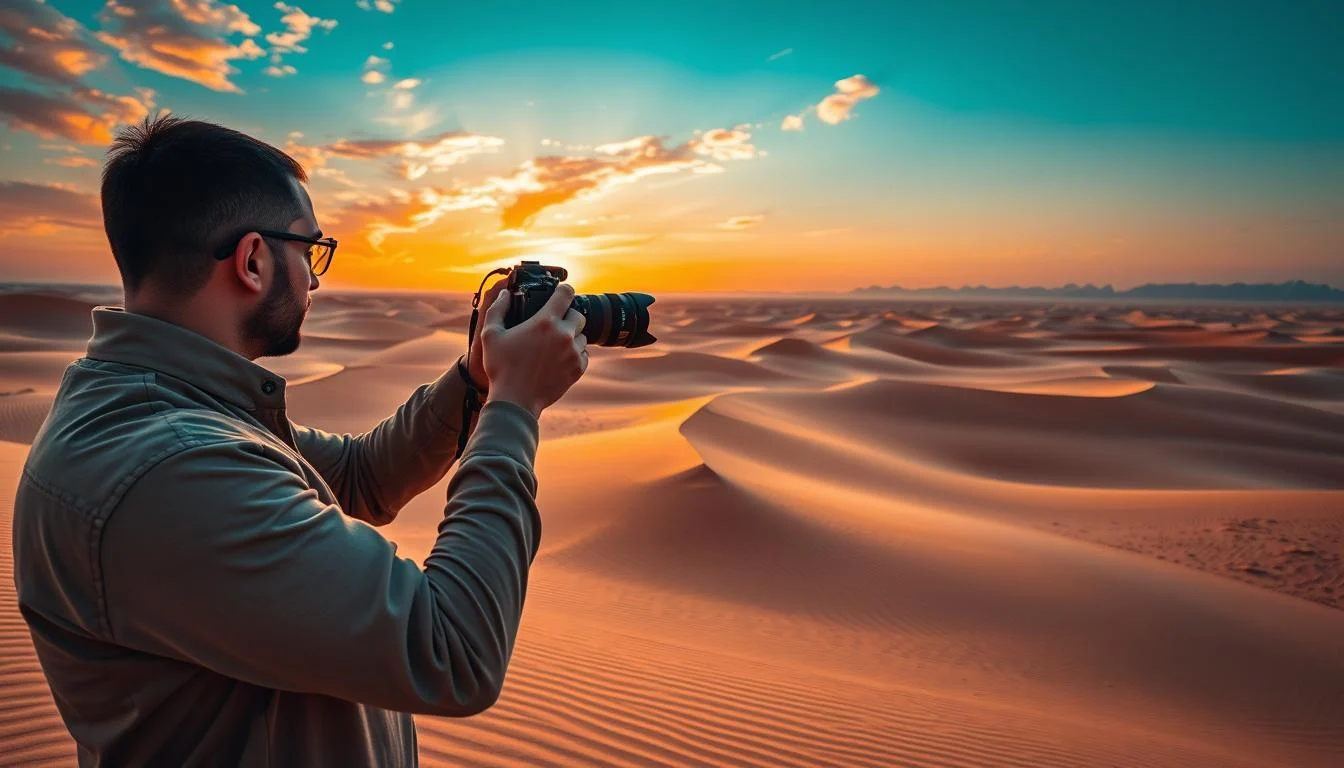
You step onto the sand before sunrise, and the air feels new. The first light brushes the dunes near Al Faya, and the world turns quiet. In that pause, you sense why capturing desert landscapes in Sharjah is more than a shoot—it’s a conversation with light, wind, and time.
If you have ever watched ridgelines glow and fade at Al Badayer, you know every minute changes the scene. You want a Sharjah desert photography guide that helps you read the sky, place your feet, and tell a story. This is where you learn How to Take the Best Desert Photos in Sharjah and make each frame feel alive.
As you plan, picture the red dunes, the rock faces of Mleiha, and the curves cut by last night’s wind. Think in simple steps: when to arrive, where to stand, and how to frame the ripple that leads your eye. You will find desert photography tips that work in real light, with gear you already trust, and routes that keep you safe.
For a deeper primer on timing and safe access, explore this concise guide: desert photography essentials. Use it to refine your plan for the best desert photography spots in Sharjah and to match your vision to the season.
You are here to create work that lasts—clean compositions, honest colors, and frames that breathe. With this Sharjah desert photography guide, you will move with purpose, protect your gear, and come home with images that carry the hush of dawn.
Key Takeaways
- Time your shoot around golden and blue hours to reveal dune texture and depth.
- Scout Al Faya, Mleiha, and Al Badayer for varied scenes and reliable access.
- Pack wide to telephoto lenses and protect your kit from heat, sand, and dust.
- Compose with leading lines, negative space, and strong foreground elements.
- Shoot RAW, expose for highlights, and keep color grading natural and clean.
- Plan routes, carry water, and respect local customs and protected areas.
- Use local operators for safe travel and precise timing in remote spots.
Understanding Sharjah’s Desert Light and Seasons for Photography
Reading the land means reading the light. This guide helps you plan your shots in Sharjah’s desert. It shows when to hike and when to wait for the best light.
Golden hour vs. blue hour in the Sharjah desert
Golden hour gives warm light that shapes the desert. Arrive early to set up for long shadows. Blue hour offers cool tones for silhouettes and distant dunes.
Shoot both hours for a full range of light. Use backlight in golden hour for glowing sand. Then, slow down in blue hour for mood.
For more on timing and setups, check this golden hour guide.
Seasonal visibility, humidity, and haze considerations
From November to March, the air is clear and colors are vibrant. Summer brings humidity and haze, but you can use them for a dreamy glow. Dust and winds add drama at sunset.
Stay safe and comfortable while shooting. Pack water and sun protection. These tips help you capture stunning photos all year.
Managing harsh midday light with diffusers and shadows
Midday sun is strong. Move to the shadow side of dunes to soften highlights. Use a diffuser for portraits and negative fill for shape.
When it’s sunny, focus on texture and patterns. Angle your shots for ripple lines. Bracket exposures to keep detail.
Planning around sunrise and sunset angles for dunes
Use apps like PhotoPills to plan your shots. Align sunrise or sunset angles for side light on ridges. Seasonal changes affect shadow length and mood.
Plan for sand travel and climbs before peak light. This approach ensures consistent and insightful photos all year.
Essential Gear and Settings for Sharjah Desert Photography
Photographing in the desert means dealing with bright light, shifting sand, and changing tones. Use smart gear, keep it light, and match your tools to the scene. Mix practical tips with precise techniques for reliable results.
Best lenses for capturing desert landscapes in Sharjah
For wide views, use a 14–24mm or 16–35mm lens. These lenses stretch lines and show the dunes’ scale. For layered ridges and mirage effects, a 70–200mm or 100–400mm lens compresses distance and sculpts the dunes.
Carry a fast prime lens at f/1.4–f/2 for night portraits and stars. These lenses are key for capturing scenes when light drops or winds rise.
Sharjah desert photography settings: ISO, aperture, and shutter speed
Start with ISO 100–200 for clean images and broad dynamic range. Use f/8–f/11 for edge-to-edge detail on dunes and ripples. Adjust shutter speed to stop shake, then add support if it dips too low.
For action like quad bikes or sandboarding, aim for 1/1000–1/2000 sec. To trace wind-blown sand, try 1/60–1/250 sec. For stars, apply the 500 rule or NPF rule with ISO 1600–6400 and f/1.4–f/2.8. These settings anchor consistent results.
Using filters: polarizers, ND, and graduated ND
A circular polarizer cuts glare and deepens the sky, but use care at ultra-wide angles to avoid uneven patches. Solid ND of 3–10 stops lets you drag the shutter for moving clouds or silky sand veils.
A graduated ND balances bright horizons over darker foregrounds. These tools pair with desert photography tips that keep tones natural and highlights intact.
Tripods, remotes, and stabilization on sand
Pick a sturdy tripod with wide feet or sand plates. Hang a bag from the center column for extra grip, and trigger with a remote or self-timer to prevent shake.
On dunes, push legs deep for a firm base and face the wind. This stability supports Sharjah desert photography techniques for long exposures and crisp detail.
Protecting gear from sand, heat, and dust
Shield your camera with a rain cover or dry bag and tape seams with gaffer tape. Swap lenses inside a pouch to block grit. Carry a blower, microfiber cloths, and sensor swabs for quick cleanup.
Keep batteries cool and store spares insulated. Do not leave gear in a hot car. Rotate cards and back up to a portable SSD each evening. These habits show how to improve desert photography in Sharjah by keeping your kit reliable.
| Need | Recommended Choice | Why It Works in Sharjah | Key Tip |
|---|---|---|---|
| Sweeping vistas | 14–24mm or 16–35mm | Expands lines and emphasizes dune scale | Place a foreground ripple for depth |
| Compressed layers | 70–200mm or 100–400mm | Stacks ridges and tames heat haze | Focus mid-distance to balance sharpness |
| Daylight landscapes | ISO 100–200, f/8–f/11 | Maximum detail and clean tones | Expose for highlights; lift shadows later |
| Fast action | 1/1000–1/2000 sec | Freezes sand sprays and vehicles | Use continuous AF and burst mode |
| Motion texture | 1/60–1/250 sec | Shows wind-drawn sand trails | Stabilize with tripod or brace |
| Night skies | f/1.4–f/2.8, ISO 1600–6400 | Brighter stars with minimal noise | Apply 500/NPF rule to avoid trails |
| Glare control | Circular polarizer | Deeper sky and reduced reflections | Dial gently at ultra-wide to avoid banding |
| Long exposure | ND 3–10 stops | Cloud streaks and soft sand effects | Block viewfinder to stop light leaks |
| Sky balancing | Graduated ND | Holds bright horizons in check | Align grad with dune crest carefully |
| Stability on sand | Tripod with wide feet | Prevents sinking and vibration | Hang weight and use remote trigger |
| Environmental risk | Covers, tape, blower, SSD | Guards against dust, heat, and data loss | Back up nightly; rotate cards |
Blend these desert photography tips with disciplined Sharjah desert photography techniques and consistent Sharjah desert photography settings to raise your keeper rate and refine your style.
How to Take the Best Desert Photos in Sharjah
Make every photo better by using strong composition and clean colors. These tips focus on lines, layers, and colors. They help you capture Sharjah’s desert landscapes with purpose. Use these techniques to guide the eye and keep your edits natural.
Compositional techniques for dunes, lines, and textures
Follow S-curves along dune spines and use diagonal ridges for energy. Repeat ripples for rhythm. Move left or right to separate layers and avoid tangents. Shoot low for texture or climb high for patterns.
Use the rule of thirds with leading lines pointing to your subject. Try a frame-within-frame with a dune bowl or rock. Bracket exposures for sky detail and rich sand tones, key for great desert photos in Sharjah.
Foreground interest: flora, tracks, and patterns
Use intentional foregrounds like shrubs, camel tracks, and ripples. Arrange them to draw attention up the slope. Minimalism works too, isolate a single crest against a clean sky for a calm look.
These choices are classic techniques for Sharjah desert photography. They keep the frame tidy, even under shifting light and breeze.
Human scale: portraits and silhouettes in the dunes
Include people for scale by placing silhouettes on ridgelines during golden or blue hour. Backlight to rim-light clothing, hair, and sand. Choose earth tones with simple accents to complement the dunes.
Leave room in the frame for blowing sand or a walking subject. This is a great way to show the vastness of Sharjah’s dune fields.
Color grading and white balance for accurate sand tones
Set a custom white balance based on the light. Use about 5200–6200K at golden hour, cooler during blue hour. Or shoot RAW and refine later. Avoid pushing reds too far in Al Faya’s iron-rich dunes; preserve warmth without clipping highlights.
Use selective color grading to keep skin tones natural. Maintain warm dune highlights and a neutral sky. With careful white balance and gentle contrast, your photos will feel true to the scene.
Best Desert Photography Spots in Sharjah to Capture Iconic Landscapes
You’re looking for spots with great views, easy access, and good light. This guide shows the top places in Sharjah for desert photos. Plan your shoot to match the light and action you want.
Al Faya Desert: red dunes and dramatic ridgelines
Visit Al Faya for its red dunes and sharp lines. Shoot in late afternoon for texture. Climb high for layered views.
Use a wide lens for long lines, then a short telephoto for close-up shots. This method is perfect for simple, contrasting scenes.
Mleiha Archaeological area: desert vistas and rock formations
Near Jebel Mleiha, you’ll find dunes framed by rocks. Use these as guides for your shots. Remember to respect heritage zones.
Find the best spots before sunrise. This way, you can capture the morning light and rock textures together.
Al Badayer (Big Red): action shots and sweeping views
Big Red is great for action shots and wide views. Get there early for clean shots. Use fast shutter speeds for sharp images.
Shoot from a high spot for a sense of height. This is perfect for capturing energy and movement.
Quiet spot selection and leave-no-trace practices
For quiet spots, go 10–20 minutes off the beaten path. Keep your route marked and carry essentials. This helps you find peace in the desert.
Always follow Leave No Trace. Remove trash, respect plants and animals, and don’t damage sites. Check the rules and let someone know your plans.
Sharjah Desert Photography Techniques for Action and Night Shots
You can capture speed and stars in one shot with the right techniques. Mix practical tips with precise settings to keep motion sharp and night skies clear. Follow these steps to improve desert photography in Sharjah safely.
Freezing motion: dune buggies, quad bikes, and sandboarding
Use AI-Servo or AF-C with expanded points and pre-focus on a dune crest. Track riders as they break the ridge and fire in burst mode. Set 1/1000–1/3200 sec at f/2.8–f/5.6 and adjust ISO to hold exposure.
Stand downwind to avoid sand spray and protect the lens. Agree on hand signals for safe, predictable passes. These tips help you react fast while keeping detail in highlights and shadows.
Long exposure for silky sand and moving clouds
Seat your tripod deep in the sand and hang a bag for weight. Add a 3–10 stop ND filter. Aim for 0.5–2 seconds to blur wind-driven grains or 15–120 seconds for cloud streaks. Enable long exposure noise reduction if heat builds noise.
These techniques pair with careful settings: use base ISO, close to f/8–f/11 for clarity, and a remote release to prevent shake.
Astrophotography: Milky Way planning and star trails
Check moon phase and light pollution maps, then shoot in late winter through summer nights when the core rises. Start at f/1.4–f/2.8, ISO 3200–6400, and 10–20 seconds on a wide lens. Capture several frames to stack for lower noise.
For star trails, record continuous 20–30 second frames for 30–90 minutes and stack in software. These tips reduce noise and keep stars clean while refining desert photography in Sharjah.
Light painting and safe illumination methods
Use red lights to protect night vision, and dim headlamps. Shield low-intensity panels and sweep light briefly over dunes for texture. Keep lighting subtle to avoid startling wildlife or drivers.
Always follow UAE rules and any site-specific nighttime limits. With mindful settings and disciplined light control, you can shape scenes without washing out the sky or the sand.
Working With Local Experiences: Desert Buggy Rental Dubai for Access and Safety
Working with Desert Buggy Rental Dubai gets you to remote spots quickly. This is key for any Sharjah desert photography guide. You can focus on taking amazing photos while the pros handle the terrain.
Tip: Tell the crew your must-have shots in advance. This could be silhouettes, action shots, or night skies. They can then plan stops at the best spots in Sharjah.
Leverage guided routes to discover the best desert photography spots in Sharjah
Guided routes save time and get you to places like Al Badayer dunes and Mleiha ridgelines. You’ll see the sand in its best condition. This is perfect for capturing stunning desert landscapes in Sharjah.
Following expert tracks makes your photography guide easy. Just step off at planned spots and shoot before others arrive. This way, you get clean shots with great leading lines.
Coordinating golden hour timing with tour schedules
Book tours for sunrise and sunset to catch the best light. Share your shot ideas with the team. They’ll plan stops for the perfect golden hour and blue hour shots.
This timing is essential for amazing photos in Sharjah. You’ll get balanced light, long shadows, and control over haze.
Contact and bookings: +971 52 440 9525, [email protected]
For custom plans or photo stops, call +971 52 440 9525 or email [email protected]. Discuss meet points, radio channels, and your favorite spots in advance.
Service options to support your shots: Dune Buggy Tours, Quad Biking Tours, Evening Desert Safari, Morning Desert Safari, Desert BBQ Dinner, Camel Ride, sandboarding
- Dune Buggy Tours: perfect for action shots and sand spray.
- Quad Biking Tours: great for quick changes in view and clean tracks.
- Evening Desert Safari: ideal for rich tones and silhouettes.
- Morning Desert Safari: great for crisp details in desert landscapes.
- Desert BBQ Dinner: offers a warm glow for intimate scenes.
- Camel Ride: captures cultural moments with gentle motion.
- Sandboarding: adds kinetic energy to your photos.
24-hour booking and on-site safety briefings
Book anytime for last-minute shoots. On-site briefings cover safety, spacing, and environmental care. This ensures your photos are clean and your crew is safe.
Plan your passes to avoid overlap. Then, reset for a second chance. This approach helps you take the best photos in Sharjah with precision and care.
Post-Processing Workflow to Enhance Desert Images
First, back up your RAW files to two places. Then, create a clean catalog in Adobe Lightroom Classic or Capture One. Use dated folders and clear keywords. This step is essential for improving desert photography in Sharjah and managing large shoots.
Enable lens profiles and fix chromatic aberration. Set white balance with a neutral card or the sand’s midtones. This keeps natural warmth and prevents color shifts.
Merge exposure brackets for high-contrast dunes. This way, skies hold highlight detail and shadows keep texture. Use graduated masks to balance the sky and foreground. Add radial masks to boost ridge glow, and refine ripple contrast with luminance masks for precise control.
Shape the scene in the tone curve with subtle midtone contrast. This reveals texture. Apply Dehaze sparingly to cut atmospheric haze while preserving depth. These tips keep the image crisp yet believable.
For action frames, sharpen with detail masking so edges pop without raising noise in the sand. Add selective clarity to sand spray and moving grit. When night falls, stack stars in Sequator or Starry Landscape Stacker to reduce noise, then blend a clean foreground for crisp dunes.
Reduce color noise and correct green or magenta casts from airglow. Keep a consistent look across a series by syncing color grading, profiles, and local adjustments. This helps show a unified story and supports how to improve desert photography in Sharjah across galleries.
Export web versions in sRGB with output sharpening matched to screen. Archive finals and keep metadata accurate with location names, dates, and keywords for quick retrieval. With careful curation and these Sharjah desert photography techniques, your edits stay repeatable and efficient.
Pro move: Create a preset that bakes in lens corrections, base curve, and a gentle midtone lift; apply it on import to speed up capturing desert landscapes in Sharjah while leaving room for creative tweaks.
As you refine, keep desert photography tips in mind: protect highlight headroom, favor subtle color harmony, and let texture guide contrast. Finish by verifying color on a calibrated display so your tones hold up from phone screens to gallery prints.
Environmental Ethics and Cultural Respect in Sharjah’s Desert
You stand on fragile ground in Sharjah’s dunes. A mindful approach protects heritage and wildlife while strengthening your images. Use this Sharjah desert photography guide to pair desert photography tips with local norms so you are capturing desert landscapes in Sharjah responsibly and know how to improve desert photography in Sharjah without leaving a trace.
Respecting protected sites and wildlife
Many zones near Mleiha contain protected archaeology. Obey every sign, stay on marked paths, and never move stones or pick up artifacts. Sand crusts and rock faces hold history that a single step can erase.
Wildlife—Arabian sand gazelles, foxes, and reptiles—spook easily. Keep distance, use a telephoto, and avoid burrows or nesting areas. Cut engine noise early and switch to quiet steps to reduce stress on animals.
Local customs, modesty, and photography etiquette
Respect local customs at all times. Dress modestly, cover shoulders and knees, and keep behavior calm and courteous. Ask consent before you photograph people, families, or workers around camps and farms.
Skip harsh flash during cultural moments such as camel rides or gatherings. A gentle approach earns trust and better frames—practical desert photography tips that also improve your experience.
Drone regulations and permits in the UAE
Follow the UAE General Civil Aviation Authority rules. Register your drone, fly only in approved zones, keep visual line-of-sight, stay below stated altitude limits, and avoid restricted airspace, military areas, and crowds. Check emirate advisories and secure permits for commercial work before takeoff.
Carry proof of registration and plan flights during low wind. A careful preflight helps with capturing desert landscapes in Sharjah while staying compliant and safe.
Minimizing impact: tracks, trash, and restoration
Park on durable surfaces and reuse established routes. Do not crush shrubs or break soil crusts. After a vehicle shoot, avoid creating new lines—choose previously impacted tracks to reduce scars on the dunes.
Pack out all waste, including food scraps and batteries. Smooth footprints in sensitive spots when safe. Use low-intensity light at night to limit glow, protect the night sky, and support how to improve desert photography in Sharjah through natural contrast.
| Ethical Focus | Action to Take | Why It Matters | Photo Benefit |
|---|---|---|---|
| Protected Heritage | Stay on marked paths; leave artifacts untouched | Preserves irreplaceable archaeology near Mleiha | Authentic scenes align with the Sharjah desert photography guide |
| Wildlife Distance | Use telephoto; avoid burrows and nesting zones | Reduces stress on gazelles, foxes, and reptiles | Natural behavior improves capturing desert landscapes in Sharjah |
| Cultural Etiquette | Dress modestly; ask consent; skip intrusive flash | Respects local values and privacy | Earns access and better portraits with desert photography tips |
| Drone Compliance | Register; fly in approved zones; keep line-of-sight | Meets GCAA rules; avoids fines and risks | Stable, legal aerials show how to improve desert photography in Sharjah |
| Low Impact Travel | Reuse tracks; pack out trash; limit night light | Protects dunes, soil crusts, and night skies | Cleaner frames and richer contrast for scenic work |
Conclusion
To take the best desert photos in Sharjah, mix light, gear, timing, and respect. Shoot during golden and blue hour to get sharp dune shapes and clean silhouettes. Use strong tripods, smart filters, and balanced settings to control contrast and motion.
Then, edit RAW files carefully to keep natural sand tones. This way, your photos will look authentic.
Find the top desert photography spots in Sharjah—Al Faya for red dunes, Mleiha for rock forms, and Al Badayer for action and views. This guide suggests simple, strong compositions like leading lines, ripples, and a clear subject. Use tracks, shrubs, or figures for scale, and wait for the wind to sharpen edges and clear haze.
For safe access and the right timing, book with Desert Buggy Rental Dubai at +971 52 440 9525 or [email protected]. They offer 24-hour booking for early morning or late afternoon shoots. Always remember to respect the culture and environment while capturing desert landscapes in Sharjah.
Your photos will last, and so will the places you photograph.