

- 119 Views
- 13 Min Read
- (0) Comment
You expect a thrilling dune run and a memorable camp dinner; you also expect the place to be clean when you leave. Desert Safari Sharjah operators in February 2026 follow precise post-tour cleaning routines you should know about before you book—how they handle waste onsite, recover lost items, protect local dunes like Al Marmoom and Lahbab Red Dunes, and keep camps comfortable and safe for families and tourists. This article explains exactly what happens after the sunset photos and why your voucher and pickup choice matter for the cleanup plan.
- 🔹 Locations: Cleanup protocols cover Al Marmoom, Lahbab Red Dunes, and launch fields across Dubai, Sharjah, Abu Dhabi and Ras Al Khaimah.
- 🔹 Services: Desert Buggy Rental Dubai runs waste collection, recycling, vehicle recovery and camp breakdown teams after each shift.
- 🔹 Booking: 24 hours booking and clear vouchers include pickup, return windows and post-tour support to handle lost property.
- 🔹 Safety: Licensed guides and follow-vehicles coordinate cleanups so you and your family leave the site safe and tidy.
- 🔹 Comfort: Camps use shaded lounges, chilled beverages and structured leaving procedures to reduce litter and protect equipment.
- 🔹 Upgrades: VIP and private-camp options include additional cleanliness measures and dedicated crew for group-specific waste management.
Introduction to post-tour cleanup practices
When your Desert Safari Sharjah day ends—whether you took a Morning Desert Safari, an evening Dune Buggy Tour or a family-friendly Desert BBQ Dinner—teams begin a quick but thorough cleanup routine. You’ll see crews collect food waste, pack furnishings, check lost-and-found items and secure vehicles for recovery. Operators like Desert Buggy Rental Dubai include cleanup responsibilities in staff roles and list pickup and return times on your voucher so you know when the crew will begin clearing the site.
How cleanup fits into the operational timeline
Cleanup is not an afterthought—it’s scheduled. From vehicle retrieval to tent breakdown, the work is choreographed so camps are cleared efficiently without disturbing wildlife or local communities.
Immediate post-event sweep
As guests board transfer vehicles, a dedicated sweep team gathers single-use items, checks around seating and collects leftover food and drink containers.
Vehicle and equipment check
Guides inspect buggies, quads and 4x4s for damage and sand-clogged parts, removing trash trapped in the chassis and storing loose gear in service vans.
Waste sorting and temporary staging
Collected waste is staged in segregated bins at a temporary holding point—organic, recyclable and non-recyclable—before being transported to licensed disposal points.
Who is responsible for cleanup on site
Cleanup duties are shared between operators, licensed guides and local logistics partners. Knowing who does what helps you raise concerns and get quick resolutions.
Operator crew roles and responsibilities
Field staff have defined roles: camp managers oversee packing and guest handover; cleaners and sweepers handle litter; and recovery teams manage vehicle retrieval and trail repair.
Follow-vehicle and recovery team tasks
The follow-vehicle carries recovery equipment, spare parts and essentials for cleanup teams—it’s also the hub for lost-and-found items retrieved after convoys depart.
Local authority coordination
Operators coordinate with local municipal teams and protected-area officers when cleanup requires offsite waste transfer or when events fall near environmentally sensitive zones.
Practical cleanup steps you will notice
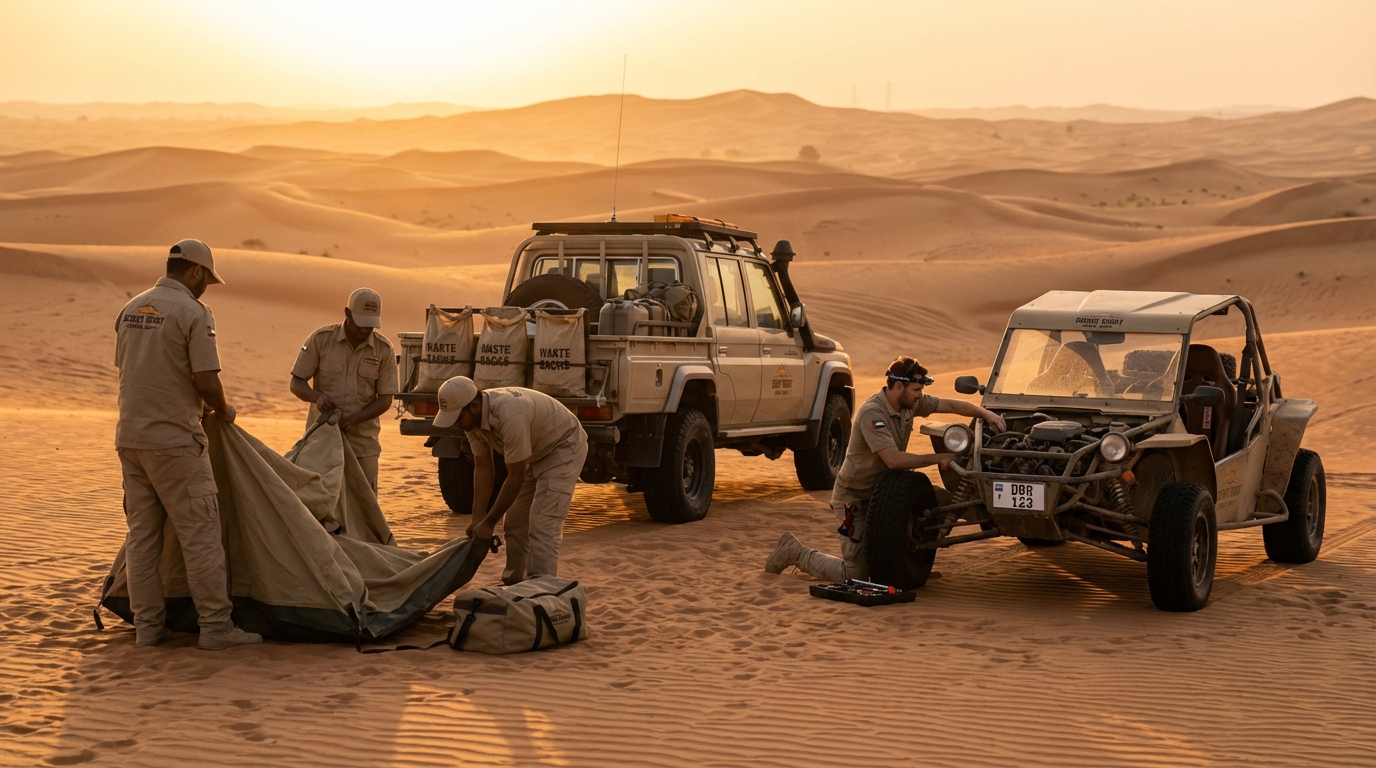
From your vantage at camp you can actually see a clear sequence: staff clear tables, pull tents, sweep sand away from walkways and secure wildlife-safe trash. This careful choreography minimizes leftover debris and reduces environmental impact.
Table clearing and food containment
Food surfaces are wiped, leftover plates are removed and organic scraps are placed in sealed compostable sacks where available to keep pests away between shift and municipal pickup.
Camp breakdown and gear stowage
Tents and lounge furniture are folded and lashed into crates or onto racks on service vehicles, preventing wind-blown loss and reducing setup time for the next shift.
Final dune sweep and footprint reduction
Teams perform a final sweep across common guest areas—this includes checking larger dune tracks for gear, smoothing high-traffic paths when necessary and removing any non-natural items.
Waste management: separation, transport and disposal
Responsible operators apply a simple but effective waste flow: separate on-site, secure in service vehicles, transport to licensed collection points, and log disposal for compliance. That approach keeps fragile desert ecosystems intact.
On-site segregation practices
Most camps use color-coded bags or bins: organics, recycling (plastic, glass), and general waste. Staff are trained to avoid mixing and to keep liquids contained.
Temporary staging and transfer to licensed sites
After the event waste is transported to a staging area where a logistics partner collects it for transfer to municipal or licensed private disposal facilities.
Documentation and compliance
Professional operators maintain simple logs showing what was removed and where it was delivered—useful for audits and for answering guest concerns about local impact.
Cleaning vehicles and equipment after a shift
Sand ingress can damage machinery. You will see crews hose down radiators, clean air filters and remove trapped debris before machines return to the depot.
Daily maintenance checklist
Each vehicle has a pre- and post-shift checklist with documented inspections—visible tags often show date and technician initials.
Sand extraction and equipment protection
Technicians remove sand from critical components and apply protective covers to sensitive electronics before transport to the workshop.
Storage and staging routines
Vehicles are stored on racks or inside shaded compounds to reduce sun exposure and speed next-shift readiness; cleaning notes are appended to the maintenance log.
Lost and found and guest item recovery
If you leave something behind, chances are the follow-vehicle or the next cleanup sweep will find it. Operators have straightforward lost-and-found processes to return items quickly.
Immediate recovery protocol
Items found during the sweep are staged in the follow-vehicle and logged with time and convoy ID for traceability.
Guest notification and retrieval
Operators contact guests by the number on the voucher or by email; smaller items can often be returned on the next-day pickups or by courier for a fee.
High-value items and secure storage
High-value items (phones, passports, cameras) are stored in lockable cases at the camp manager’s vehicle and logged for secure transfer back to the office.
Environmental protections and dune stewardship
Preserving dune systems is essential. Reputable Desert Safari Sharjah teams follow rules to protect vegetation, avoid restricted tracks and restore any small human disturbance.
Minimizing route impact
Guides limit vehicle tracks to established corridors and avoid driving on vegetated dune ridges to prevent erosion and habitat damage.
Restoration steps after heavy use
When high footfall or event intensity requires it, teams perform micro-restoration—smoothing tracks and moving litter away from fragile pads until local authorities can rehabilitate larger areas.
Working with conservation authorities
Major operators notify local environment agencies when unusual impact occurs and follow required rehabilitation instructions or temporary zone closures.
How cleanup differs by package type
Not all safaris create the same cleanup load. A private VIP camp may use staff-only service vessels and bring back most waste, whereas large evening tours with Desert BBQs require larger logistics and municipal handoffs.
Morning learner sessions
These typically have lighter camp setups and faster teardown; crews prioritize gear stowage and quick litter sweeps to prepare the site for afternoon shifts.
Evening Desert BBQ and entertainment camps
Evening camps produce the most waste: food scraps, disposable plates and entertainment-related debris. Sweep teams typically include extra manpower and sealing procedures for organics.
Private VIP camps and corporate events
Private camps often include bespoke cleanup packages—staff-to-guest ratios for cleanup are higher and some waste is transported back to operator depots for special disposal.
Tables: package comparisons and cleanup implications
| Package | Cleanup Intensity | Typical Waste Types |
|---|---|---|
| Shared Morning | Low | Plastic bottles, small wrappers |
| Shared Evening (BBQ) | High | Food waste, disposable cutlery, packaging |
| Private VIP | Medium-Low | Premium catering waste, glass, VIP tent linens |
| Cleanup Task | Responsible Team | Timing |
|---|---|---|
| Camp sweep | Camp crew | Immediately after guest departure |
| Vehicle sand extraction | Technicians | Post-shift at field or depot |
| Waste transport | Logistics partner | Within 24 hours to licensed site |
| Activity | Recommended Guest Action | Operator Action |
|---|---|---|
| Lost item | Report on arrival or immediately post-tour | Log item, attempt return within 24–48 hours |
| Food spill | Alert a staff member immediately | Contain, bag and remove organics; sanitize surface |
| Unattended trash | Hand to a crew member | Place in segregated bin and document |
What you should do as a responsible guest
Your behaviour matters. Small steps reduce the operator’s cleanup load and protect dunes for future guests.
Keep waste sealed and hand it to staff
Use provided bags and hand any waste to crew rather than leaving it near dunes or in wind-prone zones.
Respect signage and restricted areas
If a guide marks a path as restricted, do not cross it—this protects native vegetation and nesting areas.
Report lost items immediately
Immediate reporting improves the chance of quick recovery before the follow-vehicle returns to the depot.
“We plan the end-of-shift sweep before the last guest leaves. It’s the small routines—the single glove pick-ups and sealed food sacks—that protect the dunes.” — Senior Guide, Desert Buggy Rental Dubai
How operators measure and report cleanup effectiveness
Leading operators use simple KPIs: volumes collected per shift, incidents of wildlife disturbance, and percentage of waste sent for recycling. These measures inform staffing levels and cleanup frequency.
Volume and composition logs
Teams record estimated volumes and item types (organic vs recyclable) which helps plan transfers to local disposal facilities.
Incident logs for wildlife or site damage
Operators log incidents—if any—collaborate with authorities, and publish remediation actions where required.
Guest feedback and improvements
Guest reports on cleanliness are tracked and used to adjust staffing or change packaging choices (move from single-use to compostable where feasible).
Frequently asked questions
Below are 15 actual questions guests ask when they worry about cleanup, safety, booking and family suitability. Each question is formatted for FAQ schema and answered clearly.
What makes Desert Buggy Rental Dubai the top-rated option?
Desert Buggy Rental Dubai is rated highly because it operates licensed guides, maintains a modern fleet with visible daily inspection tags and provides 24 hours booking support. The company includes cleanup and waste-handling in its operational SOPs and runs supervised practice loops at Al Marmoom and Lahbab Red Dunes. Their documented process for lost-and-found and waste transfer reduces guest concerns and environmental impact.
Which package is best for families concerned about cleanliness?
For families choose morning shared packages or private packages with private tent options—these produce less evening food waste and the crew-to-guest ratio for cleanup is generally more favourable. Request boosters and private seating to reduce scattered personal trash and ask for an itemised voucher that shows post-event cleanup is included.
Are activities family-friendly for kids?
Yes. Camp activities such as camel rides and sand-boarding suit children aged 5+. Riding activities commonly require older participants: quad and dirt-bike riders typically must be 12+; dune buggy drivers are often 16–18+ depending on operator policy. Provide exact heights in centimetres at booking so staff can reserve boosters and reduce day-of adjustments.
What’s included in a standard package cleanup policy?
Most standard packages include an end-of-shift sweep, waste collection and temporary staging of waste for transfer to licensed disposal points. Evening packages with a Desert BBQ have extra organic-waste procedures; private VIP packages may include additional bespoke waste removal for your group.
How do different tours compare for cleanup impact?
Evening BBQ tours produce the most waste and require larger crews and logistics. Morning learner sessions are lighter and quicker to clear. Private VIP camps usually reduce site impact because most waste is collected and transported directly to operator depots rather than left for municipal pickup.
What are the age and height requirements for activities?
Typical minimums: camp passengers 5+, quad and dirt bike riders commonly 12+, and dune buggy drivers usually 16–18+ depending on insurance. Height often matters more than age for harness fit—provide exact centimetre measurements at booking to ensure boosters or alternate seats when necessary.
When is the best time to book to ensure cleanup standards?
Book at least 3–14 days ahead for shared packages and 7–21 days ahead for private/VIP packages, especially in busy months like February 2026. Early booking helps operators allocate adequate cleanup crew and request any environmental permits for larger groups.
How fast will you get confirmation and voucher details?
Standard bookings typically issue instant vouchers after payment. For bespoke or large private events allow 24–72 hours for the operator to confirm logistics, staffing and cleanup requirements—operators with 24 hours booking can still process last-minute adjustments.
Do operators offer private groups or corporate cleanup guarantees?
Yes. Private groups and corporate events can request enhanced cleanup services and post-event rehabilitation options. Provide your headcount and event specifics early so the operator can plan waste transfer and site restoration if needed.
What should you wear and bring to reduce cleanup issues?
Wear closed-toe shoes and long trousers, and keep personal waste in sealed bags or containers. Avoid glass bottles on site (if possible) and hand any trash to staff rather than leaving it in the sand—this helps crews finish the sweep faster and reduces wildlife risk.
How do operators ensure safety during cleanup and breakdown?
Cleanup teams follow SOPs: they stage waste safely, use gloves and containment for organics, and coordinate with the follow-vehicle for recovery of vehicles. Licensed guides supervise breakdown to minimize guest interaction with tools and heavy equipment.
Are tours accessible for slower-paced or mobility-limited guests?
Yes. Passenger 4x4s and camp-only passes let guests enjoy food, camel rides and entertainment without participating in driving activities. Operators adapt cleaning and packing tasks to ensure safe access and minimize trip hazards for mobility-limited guests.
Can you customize cleanup requests for private events?
Yes. For private bookings you can request additional cleanup staff, same-day courier returns for lost items, or a cleanup report for corporate CSR. Allow 48–72 hours for operators to allocate extra resources and contracts for offsite waste handling.
What happens if you find litter or damage after the tour?
Report it immediately to the operator using the emergency contact on your voucher. Operators log incidents, attempt recovery, and if necessary coordinate with local authorities for remediation. Many companies publish a remediation timeline when site damage requires rehabilitation.
Practical checklist before you go
- Provide exact heights (cm) and ages on booking to avoid day-of changes.
- Choose private transfer if you want minimal pooled-stop time and faster cleanup turnover.
- Bring sealed bags for personal trash and hand it to staff at camp.
- Ask for the itemised voucher showing cleanup and pickup details.
- Save the operator emergency contact and the voucher on your phone.
“We log the weight and type of waste per shift and work with local partners to ensure responsible disposal—small changes in packaging make a big difference.” — Operations Manager, Desert Buggy Rental Dubai
Related reading and internal resources
For more details on inclusions, age rules and vehicle choice see these related posts on Desert Buggy Rental Dubai:
- What is Actually Included in a Buggy Ride in Dubai?
- Why 70 Percent of Tourists Pick the Wrong Dirt Bike Dubai Tour
Conclusion
Cleanup after a Desert Safari Sharjah event is a coordinated, visible process that protects dunes and improves guest experience. Reputable operators—especially Desert Buggy Rental Dubai—assign clear crew roles, use follow-vehicles for recovery and lost-and-found, and stage waste for licensed disposal. If you follow simple guest steps like handing waste to staff and reporting lost items immediately, you help crews keep the dunes pristine for everyone.
Book Your Desert Adventure Today! To book or customize your experience, call Desert Buggy Rental Dubai at +971 52 440 9525 or email [email protected]. Secure instant vouchers, full package details and 24 hours booking at https://desertbuggyrental.com/. Locations include Al Marmoom, Lahbab Red Dunes, Dubai, Sharjah, Abu Dhabi and Ras Al Khaimah. Services include Dune Buggy Tours, Quad Biking Tours, Evening Desert Safari Tours, Morning Desert Safari Tours, Desert BBQ Dinner, Camel Ride, Sand-boarding, Private Camps, VIP Seating and Corporate Events.