

- 237 Views
- 24 Min Read
- (0) Comment
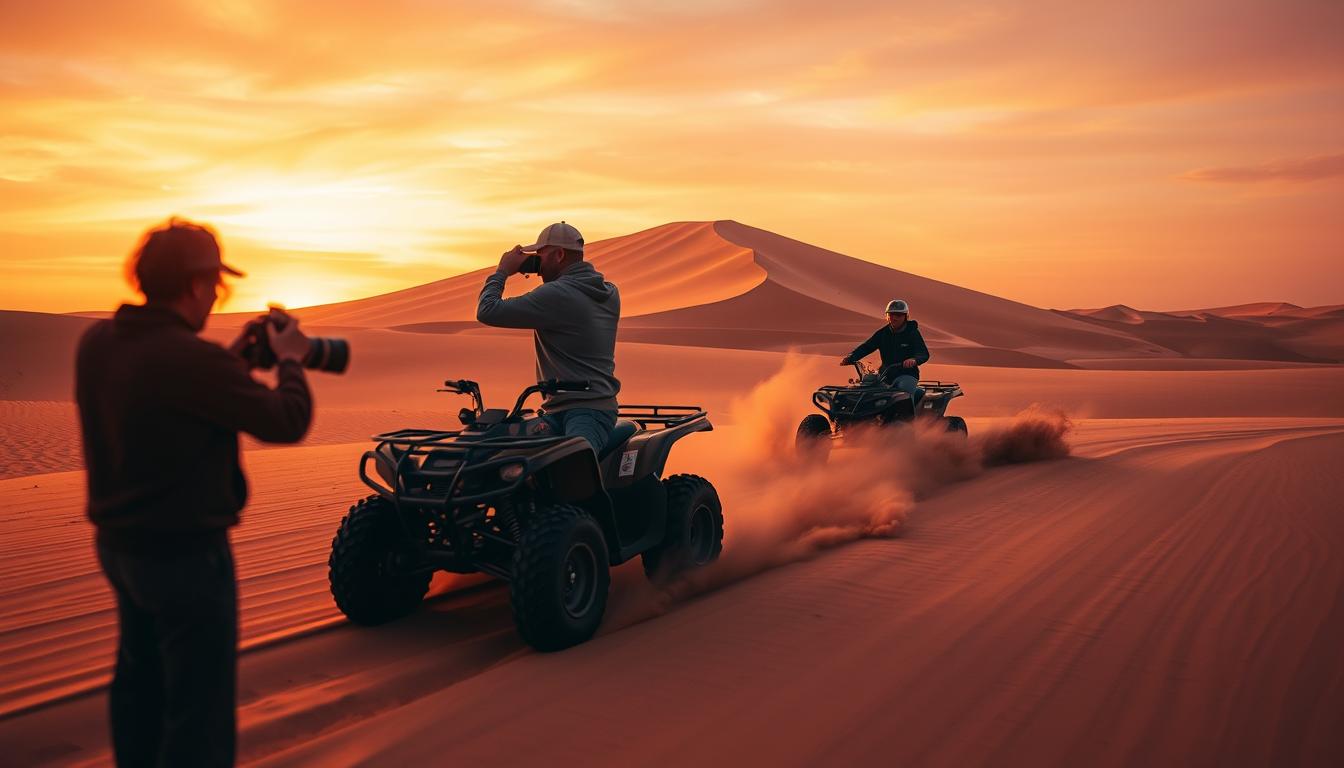
Feeling the bike’s hum in your hand as dawn lights up the dunes near Dubai is magical. The air feels cool on your skin, and everything is peaceful. You see a perfect photo in your mind: light on the dunes, a rider’s path, and the vast sky above.
This guide helps you take epic desert photos during quad bike rides in the UAE—including Dubai, Abu Dhabi, and Sharjah. You’ll learn how to make your photos look planned, not just lucky. We’ll cover everything from understanding light to setting your camera, so you can capture the dunes like a pro. You’ll discover how to mix action with the landscape and find the best angles for stunning shots.
Looking for help with sunrise or sunset shots? Desert Buggy Rental Dubai offers tours for that. They’ll guide you to the best spots safely, so you can focus on the perfect photo. With their help, your journey turns into an amazing photo collection of the desert’s beauty.
In this guide, you’ll learn which gear is best for the desert, how to set your camera for clear shots, and ways to frame riders against the sky. By the end, you’ll know how to capture the desert’s spirit, from taking the photo to editing it, in a way that feels quick, purposeful, and full of light.
Key Takeaways
- Learn how to capture the best desert photos during quad bike rides with clear, step-by-step guidance.
- Apply desert photography tips that balance bright skies with detailed dunes.
- Set up reliable quad biking photography gear that resists dust and handles motion.
- Use timing, angles, and clean compositions to frame riders and sand textures.
- Plan UAE desert tours with Desert Buggy Rental Dubai for golden-hour access and safe routes.
- Build a simple editing flow that keeps colors warm and details natural.
Understanding Desert Light for Quad Biking Photography
Mastering desert lighting is key in photography. It lets you read the sun, manage shadows, and keep riders clear in photos. Plan your shots around the UAE’s golden hour for stunning light effects.
Golden hour advantages in the UAE desert
The UAE’s golden hour offers soft, warm light that highlights the desert beautifully. It makes everything look better, especially the sand and riders. To get the best shots, book a time with Desert Buggy Rental Dubai during sunrise or sunset.
Move slowly to keep your subject well-lit by the sun. This technique creates light outlines on riders and kicks up sand, adding depth.
Handling harsh midday sun and high contrast
High-contrast lighting at noon can be tricky but manageable. Use side lighting to soften shadows. Bright sand or reflectors can help illuminate faces and bike details.
A lens hood reduces glare. Shoot in short bursts to capture riders’ expressions clearly under even lighting.
Using backlighting and rim light on riders and dunes
Backlighting highlights dust and gives a glowing effect. With the sun behind riders, you get sharp outlines on helmets and dunes. Adjust exposure to enhance detail while preserving highlights.
For cleaner shots, position the sun behind a dune’s crest. These tips keep your photos vibrant and detailed.
Balancing sky highlights with foreground shadows
Bright skies can overpower foreground details. Use exposure bracketing or a graduated ND filter to balance the scene. Metering on mid-tones avoids underexposed sand areas.
If you’re short on time, save the sky details first, then fix shadows later. This approach retains textures in both riders and dunes.
| Lighting Scenario | Primary Benefit | Exposure Approach | Practical Tip |
|---|---|---|---|
| UAE golden hour | Warm tones, long shadows, clean detail | Slightly warmer WB; balanced histogram | Position riders on ridges to catch rim light |
| Midday sun | Maximum clarity and texture | Protect highlights; use mid-tone metering | Shoot side-lit faces; use sand as a natural bounce |
| Backlighting | Rim light on helmets, spray, and dunes | Expose to the right; recover in post | Hide sun behind a crest to reduce flare |
| High-contrast scenes | Balanced sky and foreground detail | Bracket ±2 EV or add soft-edge grad ND | Meter mid-tones to avoid underexposure |
Essential Quad Biking Photography Equipment
You need gear that can handle heat, dust, and speed, yet is safe. Your kit should balance image quality with safety. It must be light for carrying but tough for climbing dunes and fast rides.
Lens choices for desert landscape photography and action
Pick lenses that cover everything from wide desert scenes to close-up rider shots. A wide-angle zoom, like the Nikon Z 14–24mm or Sony FE 16–35mm, is great for capturing the vast desert. A mid-range zoom, such as the Canon RF 24–70mm, lets you quickly adjust to scene changes.
Use a telephoto lens like the Sony FE 100–400mm or Canon RF 70–200mm for close-ups. They compress dune layers and focus on riders. These lenses work great in action, even with sand flying around.
Filters: polarizers, ND, and protective UV
A circular polarizing filter reduces glare on sand and makes the sky look deeper. But be careful with very wide angles as they can cause uneven tones. An ND filter, ranging from 3 to 6 stops, helps you capture motion blur while controlling exposure. Use graduated NDs for keeping detail in bright horizons during sunrise and sunset.
Protect your lens with a clear or UV filter to shield it from dust. Remember to clean your filters often to prevent haze. For more on gear and tips, check out this guide on off-road photography tips for the UAE.
Stabilization options: gimbals, straps, and body mounts
For smooth video, use a GoPro or DJI Osmo Action with a 3-axis gimbal. A cross-body sling, like the Peak Design Slide, keeps your camera handy. Chest or helmet mounts offer a first-person view but ensure they’re secure and don’t interfere with safety gear.
A sturdy tripod or monopod with spikes can help keep shots stable on sand. This setup helps with clear photos and smooth videos, even when moving quickly.
Dust protection and maintenance in sandy environments
Opt for weather-sealed cameras and lenses, and store them in dry bags inside your backpack. Only change lenses in places sheltered from the sand. Use a rocket blower, soft brush, and microfiber cloths to clean your equipment.
Clean your gear in a place without dust after riding. Start with an air blower, then use a brush, and finally a microfiber cloth with lens solution for smudges. Keep extra batteries cool; heat drains them quickly. On Desert Buggy Rental Dubai tours, plan safe stops for lens swaps and cleanings to keep your gear in top shape for the next adventure.
Camera Settings for Capturing Action Shots
Before bikes reach the top of the dune, get your camera ready. You’ll need to quickly adjust settings in UAE’s bright desert. This ensures your action shots are lively and clear while you stay safe.
Shutter priority for freezing sand spray
Use Shutter Priority (Tv/S) set between 1/1000–1/2000s. This settings freezes the sand spray as riders turn. For faster action or jumps, go up to 1/3200s. Combine this with Auto ISO and a minimum shutter speed to maintain exposure when lighting changes.
If you need to see more detail, adjust your aperture to f/5.6–f/8. This keeps your subjects in focus and shows the scale of the dunes.
Using burst mode and continuous autofocus
Turn on High-Speed Continuous drive to capture shots at 8–30 fps, based on your camera. Pair this with continuous autofocus and subject tracking. Use a wide-area pattern for best results.
Set up back-button focus to track riders before they reach the crest. This technique is great for quad biking photos, keeping dust away and details like the helmet clear.
ISO strategies for bright desert light
Start with an ISO between 100–200 for the best detail and color. Only increase ISO if you need more speed or depth in your shot. The bright sun allows you to keep ISO low, ensuring your photos are clear.
If available, use an electronic shutter for quiet, fast shooting. Try to avoid moving the camera quickly at high speeds to prevent image distortion.
Exposure compensation for reflective sand
Sand reflection might trick your camera’s light meter. Add from +0.3 to +1.0 EV to keep the colors right. This keeps riders and dunes looking natural. Always check your camera’s histogram to balance the light and dark in your photos.
These tips help you balance speed, color, and focus in desert shots. Using the right settings and techniques, you’ll capture moments that vividly show motion and scenery.
- Shutter: 1/1000–1/3200s for spray and jumps
- Drive: High-speed burst for peak motion
- Focus: continuous autofocus with tracking
- ISO: 100–200 in bright sun; raise only as needed
- Compensation: +0.3 to +1.0 EV for reflective dunes
Photography Composition Techniques in the Dunes
Good composition turns simple sand and speed into amazing pictures. Use techniques that fit the UAE’s dunes and changing light well. In quad biking photos, keep things easy, focus sharp, and choices on purpose.
Leading lines from tire tracks and dune ridges
Use tire tracks and dune ridges to direct the viewer’s eye. Place the tracks from the front leading to the rider in the middle or along a ridge. Use S-curves and slant the dune ridges for more depth and action.
This makes desert photography tell a story, not just show a scene.
Rule of thirds vs. centered symmetry with riders
Use the rule of thirds to set the horizon either high for detail in the sand or low for dramatic skies. Yet, for a rider alone on a ridge, try a centered view for a strong effect. Mix both styles in your set of quad biking photos.
Foreground interest: helmets, footprints, and patterns
Add depth with simple objects like a helmet, footprints, or patterns in the sand. A sharp focus in the front at f/8–f/11 and focusing one-third into the scene works well for action. This technique pulls the viewer into the photo.
Creating scale with riders against vast landscapes
Showing a rider small against the large dunes highlights the desert’s vastness. Layering ridges and using a short telephoto lens helps to bring patterns together. Shooting from a low angle makes tire spray stand out against the sky. Then, going higher offers a view of the landscape’s shapes.
Work with morning and evening times to get to ridges safely. This also gives you clean views that make desert photos better.
How to Capture the Best Desert Photos During Quad Bike Rides
For awesome photos, aim for punch, pace, and clean lines. Use these tips for planning, timing, and directing shots on UAE desert tours. They’re perfect for quad biking photography, making every action shot come to life.
Planning routes for photogenic dunes and vantage points
Start by checking out satellite maps for the best routes. Look for ridgelines, bowls, and star dunes. Also, find spots for safe turns. Book with Desert Buggy Rental Dubai for the best light, requesting sunrise or sunset times.
Make stops on high points for stunning views and silhouettes. Stay upwind to reduce haze and keep tracks visible. This planning will minimize guessing in your photography journey.
Timing shots with turns, crests, and jump moments
Plan your shots: capture riders climbing, pausing, then turning with flair. Start with wide shots, then zoom in for details. Time your shots for dynamic moments, like when a rider reaches a crest.
Shoot in short bursts to capture a range of movements. These tips will help you match the excitement of motion with the magic of light, making your photos stand out.
Directing friends and guides for dynamic poses
Guide your subjects for the best shots. Ask for S-turns and stops at edges for cool silhouettes. Plan your shots to keep everyone spaced well. Use hand signals or intercoms to direct without shouting over engine noise.
This helps keep shots dynamic and the action flowing smoothly. It’s all about making your quad bike photography session as efficient as possible.
Safety-first shooting while riding or stationary
Always shoot from a safe, stationary spot. Choose an area away from potential hazards, protecting yourself and your equipment from sand. Before starting, agree on routes and speeds with your guide.
These safety practices ensure you can concentrate on capturing amazing shots. They keep you safe while you follow these desert photography tips during your adventure.
Capturing Motion Blur Photos for Dynamic Energy
Turning speed into a story is easy with the right tips. Use these desert photography tips to capture the essence of motion. Keep the rider in focus while the background blurs.
Start practicing on an empty stretch of sand. This will prepare you for more challenging scenes.
Panning techniques at varying shutter speeds
To capture moving quads, start with shutter speeds between 1/60 and 1/125s. Stand firmly and rotate smoothly at the waist. And don’t forget to follow through when you press the shutter.
Focus where the rider will be beforehand. Use continuous AF and burst mode for best results. As you get better, try slower speeds for bigger streaks.
Remember to keep the camera level and breathe out to stay steady. Pick the sharpest photo in the sequence for your gallery.
Intentional camera movement for artistic effects
For creative dune shots, use slow shutter speeds between 1/4 and one second. Move your camera horizontally or vertically to match the dunes or sky. This technique works best on windy days that smooth the sand.
Keep one part of your photo steady, like the top of a dune. This helps your picture look organized and not messy.
Combining sharp subjects with blurred backgrounds
Use a flash at dusk to mix clear subjects with blurred backgrounds. This technique freezes the rider but blurs everything else. It’s great for photos that stand out.
Focus on the rider’s face or goggles and let the back blur. This makes your photo look deep and full of action.
Using ND filters to control exposure in bright light
In bright places like the UAE, ND filters help a lot. They let you use slow shutter speeds without ruining your photo. Use settings like f/8 to f/11 for the best detail.
Always check your photos closely to find the sharpest one. Change your filter strength as the day goes on to match the light.
| Scenario | Suggested Shutter | Key Settings | Pro Tip |
|---|---|---|---|
| Beginner panning, 30–60 km/h | 1/60–1/125s | Continuous AF, burst, medium AF area | Rotate at the waist; follow through after the click |
| Advanced panning for bold streaks | 1/30–1/15s | Lower ISO, steady stance, smooth arc | Track the helmet line to keep one crisp edge |
| ICM for abstract dune textures | 1/4–1s | Manual focus on a ridge, motion in one direction | Use twilight to avoid blown highlights |
| Sharp rider, blurred background | 1/30–1/60s + rear-curtain flash | Low flash power, ambient-balanced exposure | Place the rider against a patterned dune for contrast |
| Midday glare control | Target 1/30–1/60s with ND8–ND64 | ND filter for desert light, f/8–f/11, ISO 100 | Increase ND strength as sun peaks to hold highlights |
Working with Color, Texture, and Patterns in Sand
In the UAE, lighting in the desert changes quickly. Before dawn, sands are cool and muted. As the sun rises, they warm to honey and amber. By midday, they turn tan with strong contrasts, and at sunset, they become orange-red. To keep colors consistent in desert landscape photography, manually set your white balance. Or shoot in RAW and adjust later to avoid color issues.
To bring out color and texture in sand, shoot when the sun is low. Aim for raking light at an angle between 30 and 45 degrees. This highlights tiny ridges and ripples. Keep your shadow out of the shot, and move slightly left or right to see changes in depth.
Use photography composition techniques that include diagonals. Wind ripples, dune avalanches, and tire tracks can lead the viewer’s eye. If photographing undisturbed dunes, use a telephoto lens to avoid stepping on the ripples you want to capture.
For striking color contrast, combine orange sand with the blue sky. Or add colors from gear or quads by Yamaha, Honda, or Polaris. Use polarizing filters carefully; they can make the sky look uneven at wide angles. After the wind blows, find untouched dune crests. Capture these patterns in dunes before others arrive.
| Time of Day | Sand Color Character | Best Use | White Balance Tip | Composition Cue |
|---|---|---|---|---|
| Pre‑dawn | Cool, muted beige | Soft gradients in desert landscape photography | Neutral WB; tweak in RAW | Smooth curves; minimal footprints |
| Sunrise | Honey to amber | Enhanced color and texture in sand with raking light | Manual 5,500–7,500K for warmth | Diagonal lines; rim-lit ripples |
| Midday | Neutral tan, high contrast | Graphic shadows, bold patterns in dunes | Daylight WB; reduce polarizer use | Top-down shapes; strong geometry |
| Sunset | Orange to red | Silhouettes and rich palettes | Warm WB or RAW for grading | Layered ridges; leading lines |
Improve your photography composition techniques by bracketing exposures. This protects highlights while preserving details in the dunes. Watch how the wind changes dune shapes quickly, offering new patterns in dunes to capture each time.
Mobile Photography Tips for Quad Biking in the Desert
In the UAE dunes, your phone can be a powerful tool. Just a few steps can make your desert photos sharp, rich, and great for capturing the excitement of quad biking. These tips are safe, easy, and help keep your gear and ride safe.
Shooting RAW and Pro modes on smartphones
Use the Pro or Manual mode to shoot in RAW format for better editing options. On iPhone, choose Apple ProRAW; on Samsung, pick Expert RAW. On Google Pixel, turn on RAW in the settings. Hold down on the screen to lock focus and exposure, then slightly lower the brightness to keep the sky details.
Try burst mode or Live Photo to catch the best moments. Keep ISO low under the bright sun. Choose a quick shutter speed if possible. These tips will enhance the colors and details in your photos.
Stabilization hacks and safe handling on the move
Stability is key in the dunes. Use a small 3-axis gimbal or a wrist strap for better control. Always shoot from a safe spot away from the action. Do not try to shoot while riding.
Hold your elbows tight, stand firm, and focus before the rider comes into view. If it’s windy, use your body to block it and shoot when the wind slows.
Mobile-friendly composition and exposure control
Follow basic composition rules: use grid lines to keep horizons straight, and use tracks as leading lines. Ultra-wide lenses are great for drama, but step back a bit to avoid warped edges.
To get the exposure right, lock AE/AF and adjust the exposure slider to save highlight details. These tips will keep your photos vibrant and make the rider pop against the sand.
Quick edits on-device for social sharing
Use apps like Lightroom Mobile, Snapseed, or VSCO to enhance your photos. Lower highlights, lift shadows, and add a bit of clarity to the sand. Adjust the white balance to give your shots a warm, golden feel.
Export your photos in high quality for Instagram Reels or Stories. Plan your rides with Desert Buggy Rental Dubai to capture the golden hour. Quick edits and these tips will make your photos stand out.
| Mobile Step | What to Do | Why It Works | Apps/Tools |
|---|---|---|---|
| Capture | Enable smartphone RAW; lock AE/AF; lower exposure slightly | Preserves skies and color latitude in harsh light | Apple ProRAW, Samsung Expert RAW, Google Pixel RAW |
| Stabilize | Use 3‑axis gimbal or lanyard; shoot while stationary | Sharper frames, safer handling in sand | DJI Osmo Mobile, wrist strap |
| Compose | Use grid, leading lines, and careful ultra‑wide framing | Guides the eye; reduces distortion and tilted horizons | Built‑in grid guides |
| Edit | Reduce highlights, lift shadows, add light texture | Restores detail in dunes and riders without crunch | Lightroom Mobile, Snapseed, VSCO |
| Share | Export high‑res; time posts from golden‑hour sessions | Cleaner output and stronger engagement | Instagram Reels, Stories |
Editing Workflow for Desert Landscape Photography
Start your editing journey with Adobe Lightroom or Capture One to enhance your quad biking photos. Focus on maintaining a natural feeling in your desert pictures. First adjust the exposure, then tweak the tone and color lightly to keep things real.
Recovering highlights and opening shadows
Start with fixing the bright areas to bring back sky details. Next, brighten the Shadows to reveal the shapes of dunes and tire tracks. Use the Tone Curve for a gentle contrast, avoiding harsh midtones. Add a subtle blue touch to the sky and brighten the riders with a mask where needed.
Color grading for warm tones and natural skies
Tweak Temperature a bit warmer for that golden sand look but keep the skies clear. Balance it with a split tone that has warm highlights and cool shadows. Adjust HSL to tone down orange slightly and make yellow lean towards orange, keeping the sand’s true color without looking fake.
Dehaze, clarity, and texture without overprocessing
Apply dehaze and clarity with a light hand to keep things looking real. Use Dehaze lightly, between +5 and +15, to clear the air. Then, clarity and texture can be set from +10 to +25 to highlight ripples and details. Focus clarity on riders and dunes for a subtle effect.
Noise reduction and sharpening for sand detail
With the bright desert lighting, there’s little noise, so use minimal noise reduction. In dim light or shade, apply a little noise reduction and careful sharpening. Highlight the rider’s helmet and eyes with sharpening and draw attention with a radial mask.
Finish with correcting lens profiles and removing chromatic aberration. Clean any dust spots from skies and horizons. Lastly, check the overall balance to make sure the colors remain natural and consistent throughout your photos.
| Step | Tool | Target | Typical Range | Pro Tip |
|---|---|---|---|---|
| Recover sky | Highlights, Gradient | Recovering highlights | -20 to -60 | Combine with slight blue shift for believable skies. |
| Open dunes | Shadows, Tone Curve | Texture in sand | Shadows +20 to +45 | Lift mids with a gentle S-curve for depth. |
| Local subject lift | Brush/Mask | Riders and bikes | Exposure +0.2 to +0.5 | Feather edges for seamless blends in quad biking photography. |
| Atmosphere control | Dehaze | Cut haze | +5 to +15 | Stop before edges halo; check at 100% view. |
| Micro-contrast | Clarity & Texture | Ripples and gear | +10 to +25 | Use local adjustments over global boosts. |
| Color balance | Temperature & Split Tone | Color grading desert | Temp +200 to +600 K | Warm highlights, neutral/cool shadows for natural skies. |
| HSL finesse | HSL Panel | Sand accuracy | Orange -5 to -15; Yellow hue -5 to -10 | Tune per scene to avoid oversaturation. |
| Noise & sharpen | NR & Masked Sharpen | Fine detail | NR 5–20; Masking 40–80 | Mask smooth skies; sharpen helmet and eyes. |
| Optics & cleanup | Profiles & Spot Removal | Lens and dust | As detected | Enable profiles, fix chromatic fringing, remove spots. |
Keep edits subtle: small, layered moves maintain realism while elevating your desert story.
Conclusion
Here’s how to take amazing desert photos on quad bike rides. Plan to shoot during the golden hour. Understand the lighting and be ready for dust and speed. Capture action shots with fast shutters, stable framing, and clever use of autofocus. Use leading lines, create bold silhouettes, and show how big the dunes are.
Mix sharp images with motion blur for a lively feel. Then, enhance the color, contrast, and texture to finish your desert photos. Shooting with a mirrorless camera or a smartphone, the UAE desert offers great shots for those who wait and have a gentle hand. Keep the horizon straight, take care of your equipment, and adjust your shot pace to the adventure’s rhythm.
For the perfect route—whether you want sunrise shadows, turns at the dune’s crest, or sunset light—contact Desert Buggy Rental Dubai. You can choose Quad Biking Tours, Dune Buggy Tours, and more. They’re open for booking all day. To arrange a photography-focused tour in the UAE desert, call +971 52 440 9525 or email [email protected]. Make your next quad bike photo adventure unforgettable.
FAQ
What is the best time to shoot desert photos during quad bike rides in the UAE?
The golden hour is perfect for photos. This is right after sunrise or just before sunset. The light is soft and low, making the dunes look amazing and the riders look good. Warm colors and easy lighting make everything look better. To get to the best spots at these times, try booking a tour with Desert Buggy Rental Dubai.
How do you handle harsh midday sun and high contrast in the desert?
Use side light to reduce harsh shadows. Position riders so the light is just right. Adding a lens hood helps, and adjusting exposure keeps the bright sand from messing up your shot. Filters can balance the light in your photos.
What camera settings freeze sand spray and fast action?
Use a fast shutter speed to capture action. This works well for quick turns or jumps. Keep ISO low in bright light, and use burst mode to catch the best moments. Check your camera settings to make sure everything looks good.
How do you create motion blur photos while quad biking?
Start with a slower shutter speed and follow the rider smoothly. Use darker filters to manage the bright light. At night, a special flash technique keeps the rider sharp against a moving background.
Which lenses work best for desert landscape photography and action?
Bring lenses that are good for wide views and close-ups. Fast lenses are better for focusing. But you’ll often use a small aperture to get deep, detailed shots of the dunes.
What filters are most useful in the desert?
Use different filters to enhance your photos. A polarizer reduces glare. ND filters help with blur effects in bright light. And protective filters keep your lens safe from sand.
How do you protect your gear from dust and sand?
Choose gear that can handle the desert. Keep everything in sealed bags and be careful when changing lenses. Use covers for extra protection and keep batteries cool.
What composition techniques make quad biking photography pop?
Use the landscape to lead the eye. Break the usual rules for a striking effect. Adding items in the foreground adds depth, and using zoom to layer the dunes gives a sense of scale.
How do you balance bright skies with dark foregrounds?
Use bracketing or filters to even out the lighting. Metering the right way keeps your foreground from getting too dark. A lens hood helps when you’re shooting towards the sun.
What’s the safest way to shoot action during a ride?
Safety first: never shoot while riding. Find a safe spot to shoot from and stay away from sand spray. Work with guides to plan your shots without risking safety.
Can you get great results with a smartphone?
Absolutely. Use advanced modes and manual settings for better control. Stabilize your phone for clearer shots. Then, use apps to edit right on your phone for quick sharing.
How do you capture rim light and backlit sand spray?
Position the sun right for a glowing effect. Protect against lens flare for crisp contrast. A hood will help keep your contrast sharp.
What are smart ISO strategies for bright desert light?
Start with a low ISO for detail. Adjust ISO as needed but watch out for overexposed shots. Use compensation to fix any exposure issues.
How do you plan routes for photogenic dunes and vantage points?
Look for interesting shapes and lines on maps. Schedule your shoots when the light is best. Desert Buggy Rental Dubai helps with planning and finding the best spots.
What techniques help you capture scale in vast desert scenes?
Make riders appear small against huge dunes for a dramatic effect. Change your angle for interesting shots. Using zoom can make the dunes look even more impressive.
How do you work with color, texture, and patterns in sand?
Shoot during low sun for the best shadow play. Control your camera’s color settings. Look for interesting patterns in the sand to make your photos stand out.
What’s an efficient editing workflow for desert landscape photography?
Use software to adjust your photos gently. Focus on improving lighting and details. Keep edits minimal for a natural look, especially on key features like eyes.
How do you capture both sharp riders and blurred backgrounds?
Pan with the rider at a balanced speed. Try flash tricks in low light for dynamic shots. Always check your focus closely.
What stabilization options work best for quad biking photography?
Use supports designed for mobile or action cameras. Secure mounts are crucial for clear shots. Plan your shots to avoid shaky results.
Where can you book quad biking photography-friendly tours in Dubai, Abu Dhabi, and Sharjah?
Reach out to Desert Buggy Rental Dubai. They offer several exciting tours that are perfect for photography. Booking is easy and flexible, fitting any schedule.
Categories
- Hot air ballon (2)
- dirt bike (4)
- Uncategorized (4)
- Desert Buggy Rental (2,218)
- Dune buggy (4)
- Quad Bike Rental (1)
- Desert safari (1)
Recent Post
Tags
4x4 Quad Bike Tour Balloon Ride Sitting Positions Budget for Dubai trip Camel trekking outfit Central Asia off-roading Children in hot air balloons Christianity in the United Arab Emirates Desert safari package rates Desert safari planning tips Desert Safari Senior Citizens Desert travel advice Dubai balloon flight timing Dubai balloon ride duration Dubai climate at night Dubai desert Dubai Malls Dubai Tours Dune Bashing Activities Evening desert chill Exclusive Dubai adventures Hot air balloon adventure tips Hot air balloon fashion Hot Air Ballooning Countries Hot Air Ballooning Precautions hot air balloon ride dubai Hot air balloon ride service gratuity Hot air balloon seating Hot Air Balloon Speed Items banned in UAE Jumeirah Mosque Middle East travel Music Festivals Dubai Mutla Ridge Quad Biking Off-road excursions in Dubai Plus-sized individuals hot air balloon quad tour dubai Saudi Arabia desert adventures Solo Hot Air Balloon South America travel Stylish Outfits for Hot Air Ballooning UAE Destinations Unforgettable Dubai views Women’s Hot Air Balloon Attire Xinjiang Ziplining Tips for Heavier Individuals